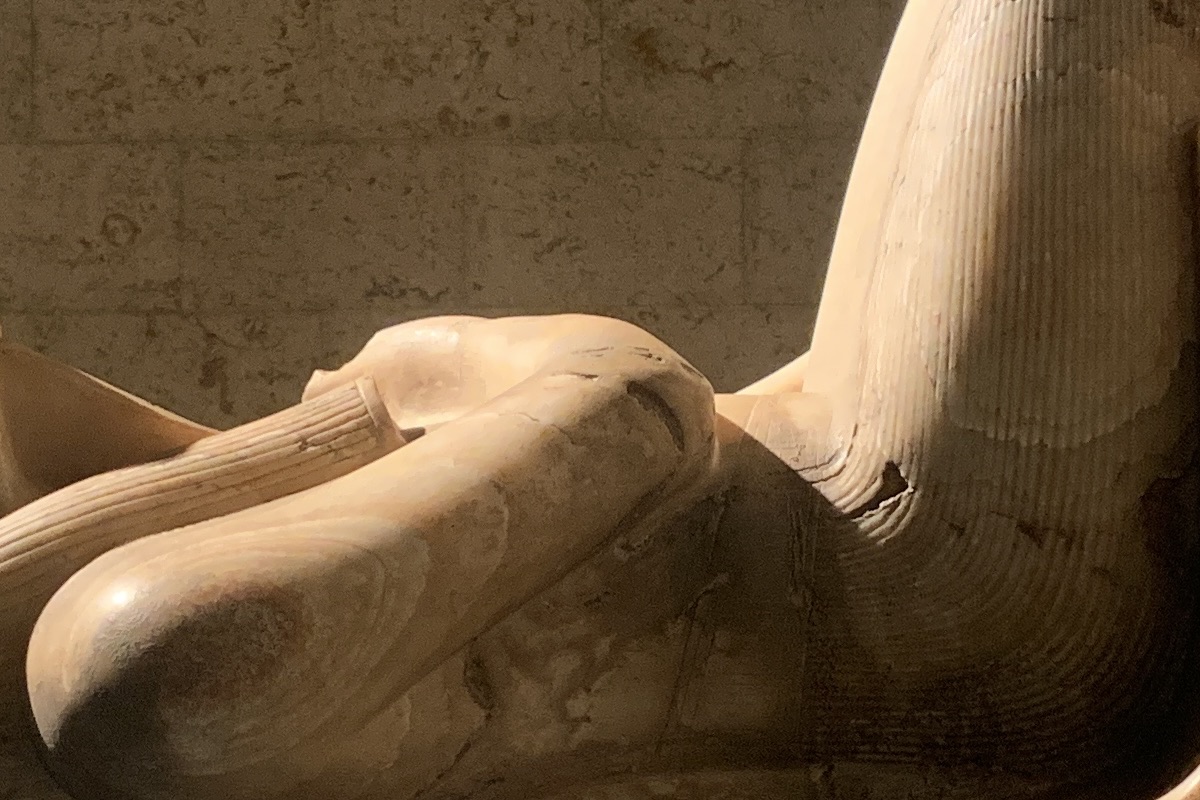
Museum photography removes size surprisingly well. A tiny amulet can fill a screen, while a royal statue is reduced to the same rectangle. In the gallery, recover physical scale before reading symbolism. Height affects eye contact, movement, labour and authority. Smallness can create intimacy or portability; monumentality can organize a crowd. Neither is a simple measure of importance.
Use your body as the first ruler
Stand at the permitted viewing distance and compare the object with your hand, head or full height. Do not touch or cross barriers. Notice whether the face meets your eyes, towers above them or fits inside a palm. The bodily comparison restores a relationship that catalogue dimensions cannot. Record the actual measurement from the label when available, then add the experience: waist-high, held close, approached from below.
Distinguish object scale from image scale
A small scarab may carry a ruler’s name, while an enormous statue may present one carefully controlled face. The represented subject and the physical carrier operate at different scales. Ask why this image needed to travel, seal, guard, confront or dominate. Portability may have enabled repeated contact, whereas large scale may have fixed an image to a route or architectural threshold.
Reconstruct the missing setting
Many sculptures now stand alone under even light. They may once have occupied a temple court, wall niche, tomb chapel or processional way. Search the label for provenance and original placement. Height, back-pillar, unfinished rear surfaces and sight lines can indicate whether an object was meant to be viewed from all sides. A museum plinth is a modern setting; do not mistake its comfortable eye level for the ancient encounter.
Count the labour implied
Large size magnifies quarrying, transport, joining and installation. Small, intricate work can demand equal concentration through drilling, polishing or minute inlay. Instead of equating bigger with harder, identify the particular challenge produced by scale. Look for modular construction, dowel holes, seams, tool access and repeated units. These clues convert an abstract dimension into coordinated human work.
Notice how the gallery edits scale
Display furniture can exaggerate or suppress size. A solitary miniature in a broad case gains visual authority; several colossal fragments in a tall atrium can appear almost architectural. Lighting and empty space tell visitors how long to look. Step back, where allowed, and observe the entire display composition. The museum is not falsifying scale, but it is actively framing your response to it.
Compare a fragment with a whole
A monumental hand, crown or inscription fragment may look like an independent sculpture. Use drawings or reconstruction diagrams cautiously to restore its relation to a larger body or building. Then return to the fragment itself. Broken scale contains two histories at once: the planned whole and the later process that separated, moved and collected a part.
Avoid the photograph trap
When making a photograph, include a legitimate scale cue such as the case edge or label, not another visitor without consent. Take one wider view after a detail shot. The pair will preserve proportion and display context. If photography is restricted, sketch the outline beside a simple human figure and note the label dimensions. A rough diagram can be more accurate for scale than a dramatic close-up.
Build a three-scale note
For one object, write its physical dimensions, the size of the represented subject and the scale of its original setting. If one is unknown, mark it as a question rather than filling the gap. This method prevents portable objects from becoming trivial and monumental ones from becoming only spectacle. Scale becomes a route into function, access and intended audience.
Watch how groups create another scale
A row of small figures, a nested set of coffins or repeated offering vessels can accumulate a presence larger than any member. Count visible units and ask whether the group was assembled anciently, discovered together or created by the museum. Repetition can express abundance, sequence or ritual provision, but a modern case arrangement can also create patterns that did not exist in the original setting. Keep those possibilities separate.
Translate dimensions into movement
Length and weight affect who could carry, open, rotate or install an object. Handles, bases, sockets and attachment points may preserve that practical relationship. Imagine movement only within the limits of physical evidence and label information: a portable shrine requires different coordination from a sealed stone sarcophagus. Asking how an object moved restores workers, bearers and installers to a story otherwise dominated by the image on its surface.
Primary sources reviewed 29 July 2026: Luxor Museum ↗ · Digital Giza ↗. Displays and visitor conditions may change.