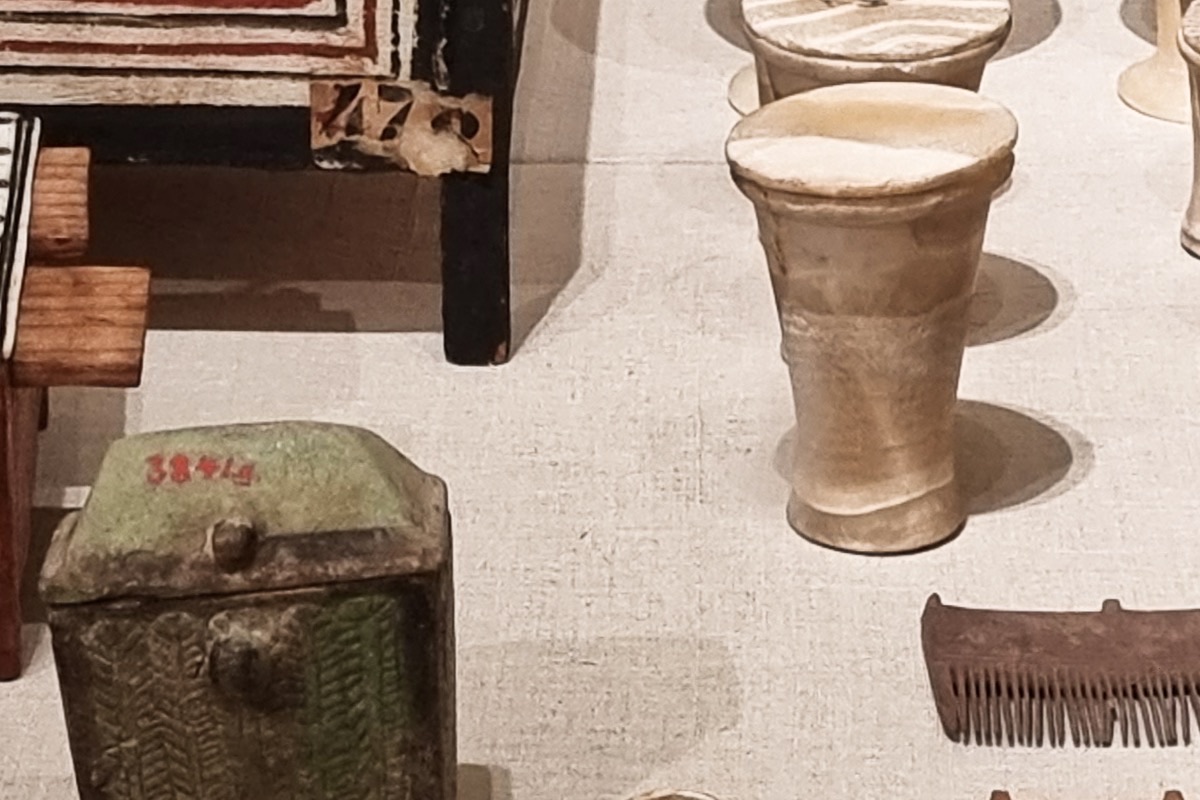
A museum label usually begins with a name, date and period. Begin one step earlier: what is the thing physically made from? Material sets limits, carries cost, responds to touch and changes after burial. A limestone relief, a bronze figure and a linen wrapping may share a date while demanding completely different labour. Naming the substance is not a minor description. It is the first claim you can test with your own eyes.
Separate substance from surface
Gold colour does not always mean solid gold, and a smooth black surface does not identify one stone by itself. Look for joins, chipped edges, corrosion, grain and areas where a coating has been lost. Those interruptions reveal layers. A wooden object may be plastered and painted; a copper-alloy figure may carry gilding; a ceramic body may disappear beneath glaze. Record each visible layer before deciding which one creates the object’s identity.
Ask what the material made possible
Hard stones support crisp edges but require long abrasion and polishing. Soft limestone accepts rapid carving yet bruises easily. Faience uses a silica-rich body and a bright glazed surface to produce colour at a scale that precious stone could not always supply. Glass can be cast, wound or blown depending on date and workshop. Material is therefore an active technology, not a neutral container for an image.
Follow the supply chain
Some substances were local to a workshop; others moved over long distances. Granite from the Aswan region, cedar imported from the eastern Mediterranean and pigments drawn from mineral or manufactured sources connect an object to extraction, transport and administration. Avoid turning every imported material into proof of luxury. Quantity, quality, reuse and archaeological context matter. The useful question is who could obtain this material, in what form and through which network.
Look for economy and substitution
Ancient makers balanced visual effect against time and availability. Paint could imitate veining, thin metal sheet could cover a cheaper core, and composite construction could place an expensive material only where it mattered most. These choices are not necessarily deception. They show an intelligent economy of attention. Compare the front, back and hidden joins: the distribution of labour often reveals which view was expected to carry meaning.
Treat damage as material evidence
Cracks, salt bloom, warping and green corrosion are not generic signs of age. Each belongs to a particular interaction between substance and environment. A conservator may control humidity, support weak fibres or leave a stable stain untouched. Ask whether a bright area is original, cleaned or restored. Never assume the most visually complete surface is the least altered one; treatment history may be part of what you are seeing.
Compare objects across one case
Choose three objects made from different substances but serving a related function—containers work especially well. Compare wall thickness, weight implied by handles, closure, decoration and wear. A stone vessel, glass bottle and pottery jar solve storage differently. The comparison converts a display case from a sequence of dates into a small laboratory of resources, skills and use.
Keep certainty proportional
You can usually describe colour, translucency, grain and visible construction with confidence. Exact alloy, pigment or stone identification may require microscopy, spectroscopy or published analysis. Use phrases such as “appears layered” or “the label identifies copper alloy” when evidence comes from different sources. This distinction keeps observation strong without pretending that a gallery visit replaces laboratory work.
Make a material field note
Write four lines: substance named by the museum; visible surface; one manufacturing trace; one later change. Add a question about supply or treatment. This compact record is more useful than photographing every label because it preserves the relationship between institutional information and your own observation. Return to the image later and test whether the photograph supports what you thought you saw.
Use touch vocabulary without touching
Museum barriers make direct handling impossible, but precise tactile language can still sharpen sight. Replace vague words such as “beautiful” with polished, granular, fibrous, hammered, pitted, translucent or layered. Base every term on a visible cue and mark it as an appearance when necessary. This vocabulary helps compare materials while respecting the object, case and conservation rules. It also prevents colour from becoming the only property you record.
Return to the label after comparison
Once you have compared several substances, reread the object label and any technical panel. Terms such as gesso, frit, copper alloy, inlay or temper may now answer a question you actually formed in front of the object. Copy the term and its source rather than treating it as your own identification. If the museum provides no manufacturing explanation, the absence becomes a focused research task instead of an invitation to guess.
Primary sources reviewed 29 July 2026: NMEC ↗ · Museum of Islamic Art ↗. Displays and visitor conditions may change.