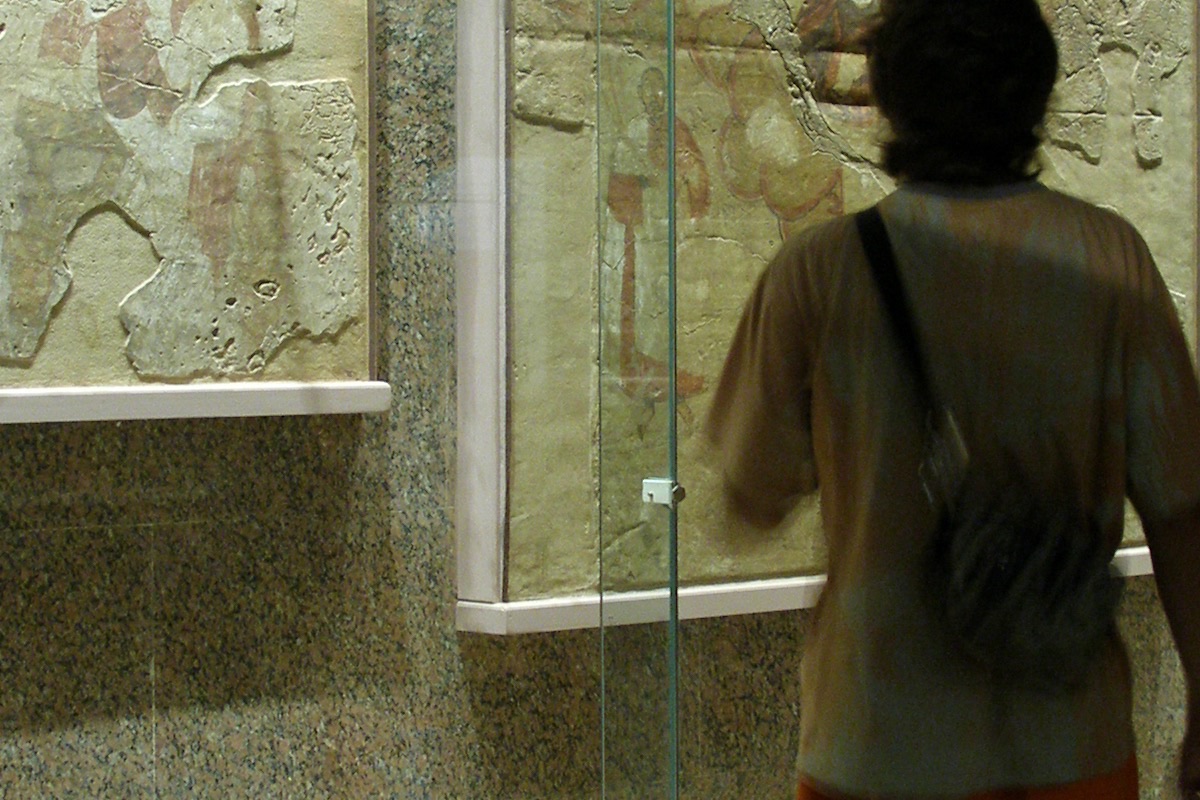
An object in a case has been separated from architecture, landscape and neighbouring finds. A place-name on the label can begin to restore those connections, but only if you ask what the name describes: discovery site, production centre, owner’s home, ancient administrative region or modern museum source. Placement turns an isolated masterpiece into archaeological evidence.
Parse the provenance line
Read every location term slowly. “From Luxor” may refer broadly to the modern city, while a named tomb, temple, house or excavation square is much more precise. “Probably” and “said to be from” signal different levels of certainty. Copy those qualifiers. Removing them makes the history look cleaner than the surviving documentation allows.
Ask where inside the site
A bowl found in a burial, workshop, street deposit or storeroom participates in a different activity even if all four contexts share a date. Look for case plans, excavation photographs and object numbers linking the display to records. Vertical position matters too: sealed floor deposits and disturbed surface layers do not carry the same evidential weight.
Connect neighbours before analogies
Museums often compare an object with visually similar examples from elsewhere. First ask what was found beside it. Tools, food remains, containers, inscriptions or architectural fragments may define use more securely than resemblance alone. An archaeological group is not automatically a complete snapshot, but documented association deserves priority over a comparison selected only for appearance.
Treat landscape as infrastructure
River channels, desert routes, quarries, fields and border zones shape movement and access. A regional museum such as the Nubia Museum can keep landscape visible even when monuments or communities have been displaced. Use maps to identify distance and direction, but avoid imagining an unchanging ancient environment. Nile courses, settlements and political boundaries shifted over time.
Distinguish origin from later movement
An object may have been made in one place, used in another, reused in a later building, excavated elsewhere and finally transferred to a museum. These are not competing provenances; they are stages in an itinerary. Write them as a timeline. Reuse can preserve an object while altering its meaning, and museum transfer can protect evidence while changing its public setting.
Look for undocumented distance
Older collections may use broad or missing provenance because excavation records were incomplete, objects entered through the antiquities market or archives were separated. Do not invent a precise context from style. Instead, note what questions become impossible to answer. Loss of place affects interpretation, not only administration.
Use the museum’s own location
A museum in Luxor, Alexandria or Aswan creates proximity between collections and regional landscapes, but “local” remains complicated. Objects may have moved nationally for conservation, security, research or display. Ask how the institution explains its geographic scope and how a regional narrative connects to wider Egyptian and Mediterranean histories.
Make a place ladder
Record five levels if available: object position, building or feature, site, region and wider network. Add a separate line for the modern collection route. The ladder prevents a famous city name from flattening precise archaeological context. It also shows exactly where information stops, which is often the most honest outcome of a short gallery visit.
Use reconstruction drawings as arguments
Plans and digital reconstructions can reconnect an object with walls, routes and neighbouring features, but every reconstruction selects evidence and fills some gaps. Read legends, dates and colour codes. Ask which parts are documented, inferred or hypothetical. Then compare the drawing with the surviving object rather than letting the clean image replace it. A useful reconstruction makes uncertainty visible and directs you back to archaeological records.
Record modern place-names carefully
Ancient sites may be known through several historical and modern names, transliterations or administrative areas. Copy the form used by the museum and add alternatives only from a reliable source. Do not assume two similar names describe identical boundaries. Precise naming matters for later catalogue searches, and it respects the fact that archaeological landscapes remain part of modern towns, villages and communities.
Primary sources reviewed 29 July 2026: Nubia Museum ↗ · UNESCO Nubian Monuments ↗. Displays and visitor conditions may change.